Top 10 Technology Trends and Devices to Watch in 2026
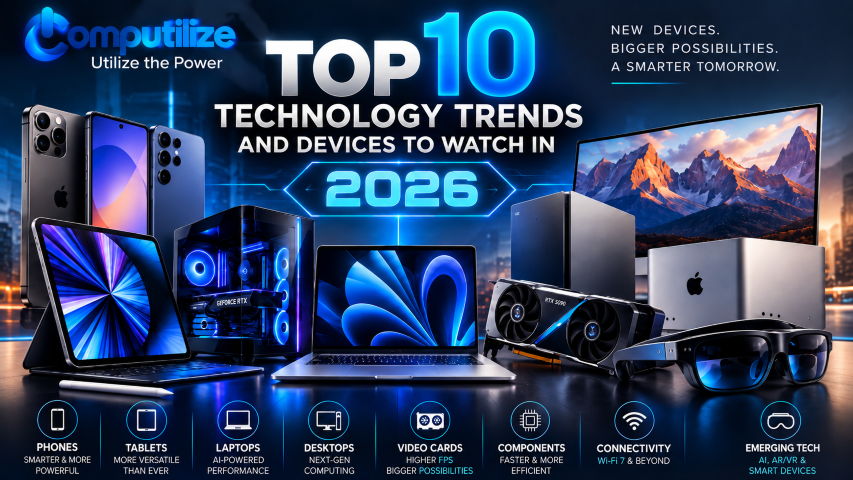
Technology in 2026 is moving in several directions at once. Smartphones are becoming more intelligent, tablets are getting closer to full laptop replacements, laptops and desktops are adding dedicated AI hardware, graphics cards are leaning heavily into neural rendering, and faster networking is changing what we can do at home and at work.
For small businesses and home users, the biggest story is not simply that devices are getting faster. New hardware is becoming more efficient, more connected, and increasingly capable of running artificial intelligence directly on the device.
Quick Take: What Is Changing Fastest in 2026?
- Phones: better cameras, stronger batteries, faster chips, and more on-device AI.
- Tablets: more desktop-class performance, better displays, and stronger productivity software.
- Laptops: dedicated NPUs and AI-focused processors are becoming standard.
- Desktop PCs: compact systems are getting surprisingly powerful while high-end towers continue to push performance.
- Graphics cards: AI-assisted rendering, frame generation, and neural graphics are becoming central features.
- Networking: Wi-Fi 7 is moving from premium novelty toward a practical upgrade for busy homes and businesses.
- Wearables: smart glasses and spatial computing are becoming much more serious computing platforms.
1. Smartphones Are Becoming Personal AI Computers
The smartphone remains the device most people use every day, but 2026 phones are becoming much more capable than simple communication devices.
Apple’s iPhone 18 Pro and iPhone 18 Pro Max introduced the A20 Pro chip, expanded on-device AI capabilities, Wi-Fi 7, improved thermal management, and a new variable-aperture camera system. Google’s Pixel 11 family uses the Tensor G6 chip and deeper Gemini integration to provide more proactive assistance directly from the phone.
What this means for users
- More AI tasks can happen directly on the phone.
- Camera systems continue to improve in low light, zoom, video, and computational photography.
- Battery life and thermal management are receiving more attention alongside raw performance.
- Wi-Fi 7 and newer wireless technologies are appearing in flagship devices.
- Phones are becoming increasingly useful for business productivity, content creation, and remote work.
2. Foldable and Multi-Screen Phones Are Maturing
Foldable phones are no longer just experimental technology. Manufacturers are continuing to improve hinges, displays, durability, multitasking, cameras, and software designed specifically for larger folding screens.
Devices such as Google’s Pixel 11 Pro Fold and the latest generation of premium foldables demonstrate how manufacturers are trying to combine a phone and small tablet into one device.
- Larger screens without carrying a separate tablet
- Better multitasking and split-screen applications
- Improved designs that are thinner and more practical
- More competition in premium foldable devices
- New opportunities for productivity and mobile content creation
3. Tablets Are Becoming Serious Productivity Machines
Tablets continue to blur the line between mobile devices and traditional computers.
Apple’s M5-powered iPad Pro brought stronger AI performance, faster storage, and Wi-Fi 7 to an already powerful tablet platform. Samsung’s newly announced Galaxy Tab S12 series combines large OLED displays, the S Pen, Galaxy AI, long battery life, and productivity-focused software.
Why tablets matter more in 2026
- High-performance chips can handle demanding creative applications.
- Keyboard and stylus accessories make tablets better for business and school.
- Desktop-class applications are becoming more common.
- OLED displays provide excellent image quality for media and creative work.
- AI tools are being integrated into note-taking, image editing, research, and productivity.
4. AI Laptops Are Becoming the New Normal
One of the biggest changes in personal computing is the rise of the AI PC. Modern laptops increasingly include a dedicated neural processing unit, or NPU, alongside the CPU and GPU.
Intel launched its Core Ultra Series 3 processors in 2026, while AMD, Qualcomm, and Apple continue to push local AI performance in their own platforms. Microsoft’s Copilot+ PC requirements have helped make dedicated AI hardware an important part of the Windows laptop market.
Apple also refreshed the MacBook Pro with M5 Pro and M5 Max chips, emphasizing stronger local AI performance, graphics, faster SSD storage, Wi-Fi 7, and Thunderbolt 5.
What to look for in a 2026 laptop
- A modern CPU with a dedicated NPU
- At least 16GB of memory for most serious users
- Fast NVMe storage
- Good battery efficiency
- Wi-Fi 7 if you plan to keep the computer for several years
- A dedicated GPU if you game, edit video, work with 3D graphics, or run heavier AI workloads
5. Desktop Computers Are Getting Smaller and More Powerful
Desktop computers are going in two directions: extremely compact systems for everyday and professional use, and high-performance towers built for gaming, content creation, engineering, and AI workloads.
Apple’s new Mac mini and Mac Studio illustrate how much computing power can now fit into a relatively small desktop. The Mac mini with M6 emphasizes local AI and everyday productivity, while the Mac Studio with M5 Max or M5 Ultra targets demanding professional workloads.
On the Windows side, new prebuilt desktops combine the latest Intel and AMD processors with NVIDIA GeForce RTX 50 Series or AMD Radeon RX 9000 Series graphics cards.
- Compact desktops can now handle workloads that once required much larger systems.
- High-end desktops remain easier to upgrade and customize than most laptops.
- Local AI workloads are becoming an important reason to choose more memory and stronger GPUs.
- Creators and small businesses have more workstation-class options than ever.
6. Desktop Processors Are Pushing Gaming, Creation, and AI Further
Desktop processors have continued to advance in 2026, especially for gamers, creators, developers, and workstation users.
AMD released the Ryzen 9 9950X3D2 Dual Edition with dual 3D V-Cache technology and 208MB of total cache, while its Ryzen PRO 9000 lineup brings high-core-count Zen 5 processors to professional systems. Intel expanded its desktop lineup with the Core Ultra 200S Plus series, including the Core Ultra 7 270K Plus.
Why this matters
- Games can benefit from larger cache and stronger single-thread performance.
- Video editing, 3D work, compiling, and data analysis benefit from more cores.
- Modern platforms offer faster memory, storage, and PCIe connectivity.
- Businesses can choose systems ranging from efficient office PCs to full workstations.
7. Graphics Cards Are Becoming AI Accelerators Too
Graphics cards are still critical for gaming, but GPUs are now just as important for AI, content creation, video processing, 3D rendering, and other compute-heavy work.
NVIDIA’s GeForce RTX 50 Series, based on the Blackwell architecture, continues to be the company’s current gaming and creator generation in 2026. AMD’s Radeon RX 9000 Series provides strong competition, while both companies increasingly use AI-assisted rendering technologies to improve image quality and performance.
The big GPU trends
- AI-assisted frame generation
- Neural rendering and image reconstruction
- Faster ray tracing
- More capable creator and video workflows
- Local generative AI and machine-learning workloads
- Power efficiency becoming increasingly important in laptops
For many users, the graphics card is becoming the most important component after the CPU when choosing a performance computer.
8. Wi-Fi 7 Is Becoming a Practical Upgrade
Wi-Fi 7 is gradually moving beyond high-end early-adopter equipment and into phones, tablets, laptops, desktops, routers, and mesh systems.
The advantage is not simply a bigger speed number. Wi-Fi 7 is especially useful in environments with many connected devices, where newer features can improve capacity, latency, and reliability.
- Busy homes with phones, TVs, cameras, tablets, and smart-home devices
- Home offices with large file transfers and video calls
- Small businesses with many wireless devices
- Gaming and streaming environments
- Newer devices that support multiple Wi-Fi bands more efficiently
You do not necessarily need to replace a good Wi-Fi 6 or Wi-Fi 6E network immediately, but Wi-Fi 7 is increasingly worth considering when buying a new router or building a network meant to last several years.
9. Thunderbolt 5, PCIe 5.0, and Faster Storage Are Removing Bottlenecks
The less glamorous parts of a computer are also improving quickly. Faster connectivity and storage can dramatically change how responsive a workstation feels.
- Thunderbolt 5 can support extremely fast external storage, docks, displays, and expansion hardware.
- PCIe 5.0 provides more bandwidth for high-performance SSDs, graphics, and workstation expansion.
- Faster NVMe SSDs reduce load times and improve workflows involving large files.
- 2.5Gb and 10Gb Ethernet are becoming more common on higher-end systems and networks.
These upgrades are particularly valuable for video editors, photographers, developers, businesses working with large files, and anyone using network-attached storage.
10. Smart Glasses and Spatial Computing Are Moving Toward the Mainstream
One of the most interesting technologies to watch is the move from phones and screens toward wearable computing.
Meta expanded its AI glasses lineup in 2026, while Snap introduced SPECS augmented-reality glasses designed to place digital information directly into the user’s physical environment. Meta also introduced lightweight VR Glasses scheduled for 2027, showing where spatial computing may be headed next.
- Hands-free AI assistants
- Live translation
- Navigation and contextual information
- Photography and video from the user’s point of view
- Virtual workspaces and multiple virtual displays
- Augmented-reality applications that mix digital content with the real world
Smart glasses are still an emerging category, but 2026 has made it clear that major technology companies see wearable AI and spatial computing as an important part of the future.
What Should Small Businesses Pay Attention To?
Not every business needs the newest phone, fastest GPU, or latest AI computer. The more important question is whether new technology solves a real problem.
- Replace aging computers that are slowing down everyday work.
- Consider AI-capable laptops if local AI and long battery life are useful to your workflow.
- Upgrade networking when unreliable Wi-Fi is affecting productivity.
- Invest in stronger graphics hardware when video, design, 3D, AI, or specialized software requires it.
- Choose hardware with enough memory and storage to remain useful for several years.
- Avoid paying for features you are unlikely to use.
Frequently Asked Questions About 2026 Technology
Do I need an AI PC in 2026?
Not everyone needs to replace a recent computer just to get an NPU. However, if you are already shopping for a new laptop or desktop, choosing a modern platform with dedicated AI hardware can provide better long-term support for new operating-system and application features.
Is Wi-Fi 7 worth upgrading to?
It can be, especially if you have many connected devices, fast internet service, a busy home office, or are replacing an older router anyway. A good Wi-Fi 6 or Wi-Fi 6E system may still be perfectly adequate for many users.
Should I upgrade my graphics card?
Upgrade when your current GPU no longer provides the performance you need. Gaming resolution, monitor refresh rate, creative applications, AI workloads, available power supply, and budget are more important than simply owning the newest generation.
Are tablets replacing laptops?
For some users, yes. Modern tablets can handle email, documents, web work, creative applications, meetings, media, and many business tasks. Traditional laptops still offer advantages in software compatibility, multitasking, ports, and specialized professional applications.
What is the most important technology trend of 2026?
The broadest trend is the movement toward on-device intelligence. Phones, tablets, laptops, desktops, graphics cards, and even smart glasses are being designed to process more AI locally instead of depending entirely on cloud computing.
The Best Technology Is the Technology You Can Actually Use
2026 has brought faster processors, more capable phones, stronger graphics cards, better tablets, smarter laptops, improved networking, and entirely new forms of wearable computing. But buying the newest technology is not automatically the same as making a good technology decision.
At Computilize, we focus on what the technology can actually do for you. Whether you are upgrading a home computer, choosing equipment for a small business, improving your Wi-Fi, building a desktop PC, selecting a laptop, or trying to understand where AI fits into your technology, the goal is the same: choose the right tools and put them to practical use.
Utilize the Power.