How AI Can Benefit Small Businesses and Home Users
Artificial intelligence is no longer something reserved for large corporations or technology companies. Today, AI tools are practical, affordable, and increasingly useful for small businesses, home-based businesses, and everyday home users.
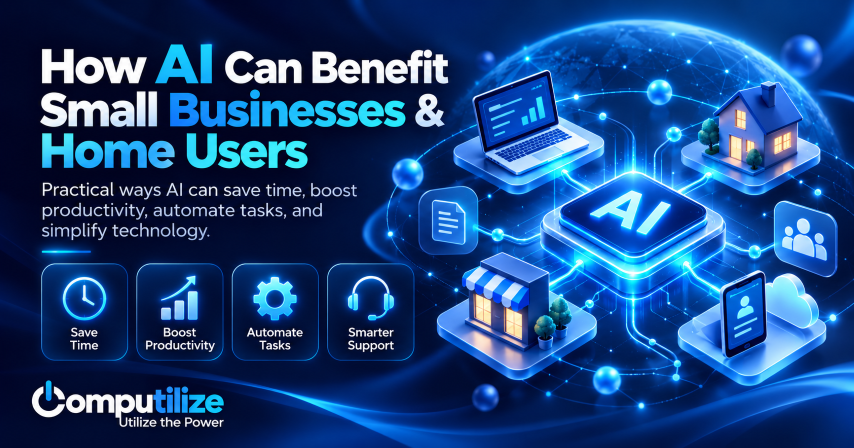
From writing emails and organizing information to automating repetitive tasks and simplifying everyday technology, AI can help people save time, improve productivity, and make better use of the tools they already have.
Quick Take: Where AI Can Help Most
- Save time: Draft emails, summarize documents, organize notes, and create checklists faster.
- Boost productivity: Turn rough ideas into organized plans, outlines, reports, and content.
- Automate repetitive work: Reduce manual data entry, routine follow-ups, and recurring administrative tasks.
- Improve customer service: Use AI-powered chatbots and faster response workflows.
- Support marketing: Generate ideas for websites, blogs, email campaigns, social media, and promotions.
- Make technology easier: Get plain-language explanations, troubleshooting guidance, and step-by-step help.
What Does AI Implementation Really Mean?
AI implementation does not necessarily mean replacing employees, buying expensive software, or rebuilding the way a business operates. In many cases, it simply means using AI to improve one part of a workflow.
For a small business, that might mean using an AI assistant to draft customer emails, summarize meeting notes, create marketing content, or answer common questions. More advanced implementations can connect AI with automation, websites, customer management systems, document processing, scheduling tools, and other software.
For home users, AI can help with writing, research, planning, learning new technology, organizing projects, understanding computer problems, and completing everyday tasks more efficiently.
How AI Can Help Small Businesses
Small-business owners often handle many responsibilities at once. AI can reduce some of that workload by helping with tasks that are repetitive, time-consuming, or difficult to start.
Practical Uses for Small Businesses
- Drafting and improving customer emails
- Creating website and landing-page content
- Generating blog and social media ideas
- Writing product and service descriptions
- Summarizing meetings, documents, and notes
- Preparing outlines, reports, and presentations
- Organizing leads and customer inquiries
- Creating frequently asked questions and support content
- Assisting with customer service through AI chatbots
- Automating repetitive administrative workflows
AI works best when it supports human decision-making rather than replacing it. Business owners should still review important customer communications, marketing content, recommendations, and decisions before they are used.
AI Can Improve Everyday Productivity
AI can function like a digital assistant that helps turn information into something more useful. Instead of starting every task from a blank page, you can use AI to create a first draft, organize your thoughts, or identify the next steps.
- Summarize lengthy documents
- Turn notes into organized action items
- Create checklists and project plans
- Explain technical subjects in plain language
- Compare options and organize pros and cons
- Brainstorm ideas for projects or marketing
- Prepare schedules and task lists
- Rewrite complicated information more clearly
The goal is not to remove people from the process. It is to reduce unnecessary work so people can spend more time making decisions, helping customers, completing projects, and focusing on higher-value tasks.
How AI Can Help Home Users
The benefits of AI extend far beyond business. Home users can use AI as a practical assistant for everyday technology, planning, learning, and organization.
Everyday AI Ideas for Home Users
- Write or improve letters and emails
- Create meal plans and shopping lists
- Plan trips and household projects
- Understand unfamiliar computer errors
- Learn how software, phones, and apps work
- Organize photos, files, and digital information
- Compare products and features
- Create schedules, reminders, and checklists
- Get step-by-step explanations for unfamiliar technology
- Brainstorm hobbies, projects, recipes, and activities
For beginners and seniors, AI can also make technology more approachable by allowing people to ask questions in normal language instead of trying to understand technical terminology.
AI and Automation Work Best Together
One of the biggest opportunities for small businesses comes from combining AI with automation. AI can help understand, create, summarize, or categorize information, while automation can move that information between systems and trigger the next action.
For example, a website inquiry could be collected, categorized, entered into a customer management system, and followed by an email notification or follow-up task.
Examples of AI + Automation
- Route website leads to the correct person or service
- Create follow-up tasks from customer inquiries
- Summarize form submissions or support requests
- Prepare recurring reports
- Reduce repetitive data entry
- Organize incoming emails or documents
- Generate draft responses for review
- Connect website forms with business software
Before choosing an AI tool, ask: “What task is taking too much time, creating frustration, or being repeated unnecessarily?”
A Simple Way to Start Using AI
- Identify the problem. Find a task that takes too much time or feels unnecessarily repetitive.
- Choose one small use case. Start with something manageable instead of trying to automate everything.
- Test the tool. See whether the AI actually improves speed, quality, or convenience.
- Review the results. Keep a human involved, especially for important customer, financial, legal, or business information.
- Expand gradually. Once one workflow is working well, look for the next opportunity.
Security and Privacy Still Matter
AI should be implemented thoughtfully. Before entering confidential customer information, financial data, passwords, proprietary documents, or other sensitive information into an AI system, understand how that service handles data.
- Do not enter passwords or sensitive account credentials into an AI chat.
- Be cautious with customer, financial, medical, or confidential business information.
- Review the privacy and data-handling settings of the AI service you use.
- Create clear guidelines for employees if AI is being used in a business.
- Verify important AI-generated information before acting on it.
Frequently Asked Questions About AI
Is AI only useful for large companies?
No. Many of the most practical AI tools are accessible to small businesses, home-based businesses, and individual users. You can start with simple tasks such as writing, summarizing, planning, customer communication, or research.
Do I need technical experience to use AI?
Not necessarily. Many AI tools are designed around normal conversation. The biggest challenge is often learning what to ask, how to give clear instructions, and how to evaluate the answer you receive.
Can AI automate my entire business?
AI can automate parts of a business, but trying to automate everything at once is usually not the best approach. It is generally more practical to identify specific repetitive workflows and improve them one at a time.
Can AI help with customer service?
Yes. AI can help answer common questions, guide website visitors, draft responses, categorize inquiries, and collect contact information. Human support is still important when a customer needs a quote, detailed troubleshooting, or a decision that requires judgment.
Is AI safe to use with private information?
You should be careful with private or sensitive information. Before sharing customer data, financial information, confidential business documents, or personal information, review the privacy and data-handling policies of the AI service you are using.
What is the best way for a small business to start with AI?
Start with one clear problem. Look for a repetitive task, a communication bottleneck, or a process that takes too much time. Test AI on that one task, measure whether it helps, and expand from there.
Start With the Problem, Then Choose the Technology
The biggest mistake many people make with new technology is starting with the product instead of the problem.
At Computilize, we believe the better approach is to first determine what you are trying to accomplish. Maybe you want to respond to customers faster, reduce administrative work, improve your website, learn how to use ChatGPT, or make everyday technology easier.
Once the goal is clear, it becomes much easier to determine whether AI, automation, better software, improved processes, or a combination of technologies is the right solution.
Utilize the Power of AI
Artificial intelligence represents another major evolution in the way people interact with technology. For small businesses, it can provide access to capabilities that once required larger teams or expensive systems. For home users, it can make information, productivity tools, and technology assistance much more accessible.
Computilize is a portmanteau of the words computer and utilize. That idea fits directly with how we approach AI: technology itself is only a tool. Its real power comes from knowing how to put it to practical use.
If you are interested in implementing AI in your small business, home-based business, or everyday technology routine, Computilize can help you understand the options, choose practical tools, and develop an approach that fits the way you actually work and live.
Utilize the Power.